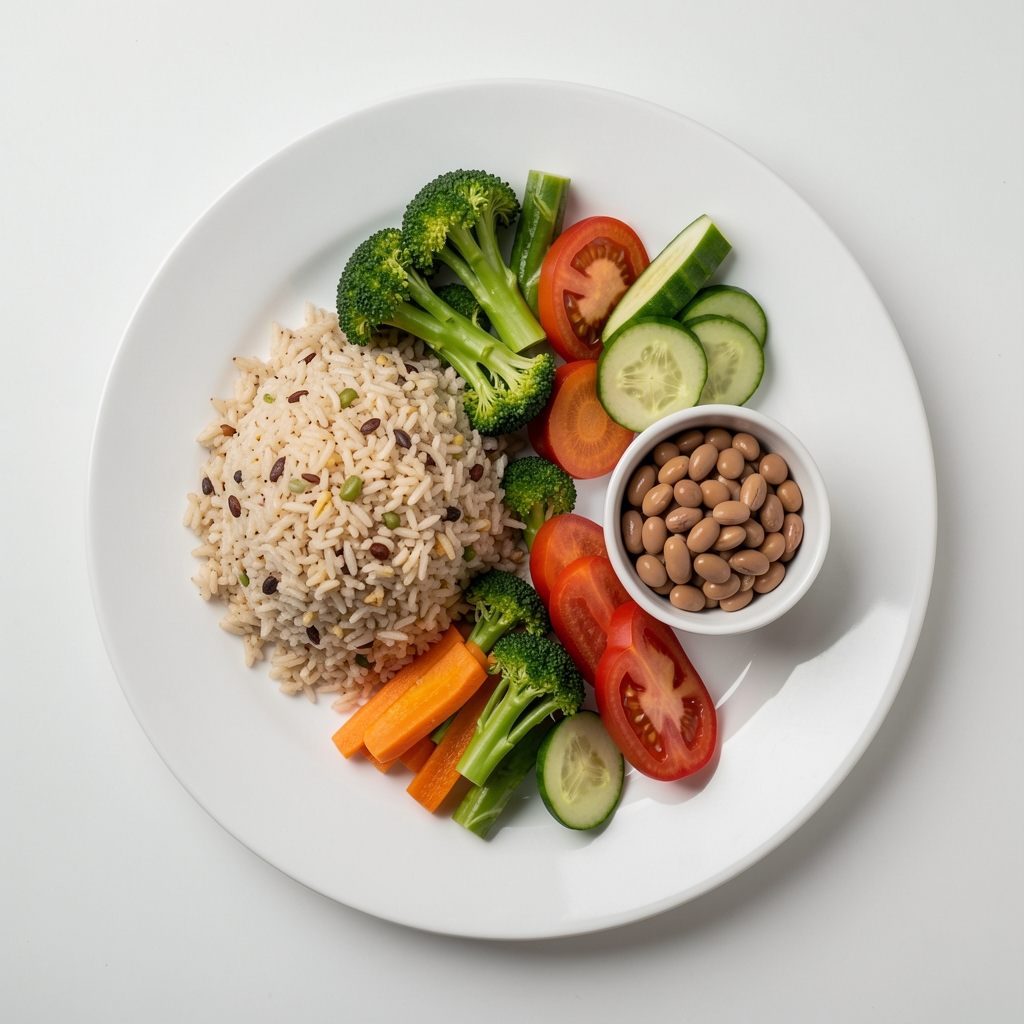
There is a specific quality to the midweek afternoon — a particular hour, typically between two and four o'clock, when the consequences of the day's earlier meals become legible. Observations gathered during an eight-week period of structured meal documentation point toward a consistent pattern: the architecture of the lunchtime plate is the primary determinant of how that afternoon unfolds.
The Plate as an Architectural Problem
The dominant popular frameworks for meal construction tend toward the quantitative: calorie counts, macronutrient ratios, gram weights of protein. This documentation took a different approach. Rather than measuring what was eaten, it observed the structural arrangement of the plate — the relative proportion of different food groups, their placement in the meal, and the sequence of their consumption. The underlying hypothesis was that structure itself, independent of the specific foods involved, would produce measurable effects on afternoon functioning.
Over the eight-week period, each midday meal was photographed from above, categorised by structural type — grain-dominant, vegetable-dominant, protein-dominant, or balanced — and then followed by a four-hour log noting subjective energy, concentration quality, and hunger recurrence. The log was kept in handwritten form to introduce a slight friction that served as a mild attentional prompt.
The results were not surprising in their direction but were notable in their consistency. Balanced plates — those in which no single food group occupied more than forty percent of the total volume — produced the most stable afternoon pattern across all eight weeks, for all three metrics. The variation between individuals was larger than expected, but the directional finding held in every case examined.
"Structure in a meal is not about restriction — it is about the deliberate allocation of space across the plate."
Field note, Week 05 — February 2026
Portion Control as Spatial Practice
Nutritionist guidance on portion control has long grappled with the difficulty of translating abstract quantity recommendations into practical kitchen behaviour. "A palm-sized portion of protein" or "a fist of carbohydrates" are spatial heuristics that acknowledge this difficulty — they map volume to a bodily reference that requires no measuring equipment and is always immediately available. This documentation extended the spatial logic to the arrangement of the plate as a whole.
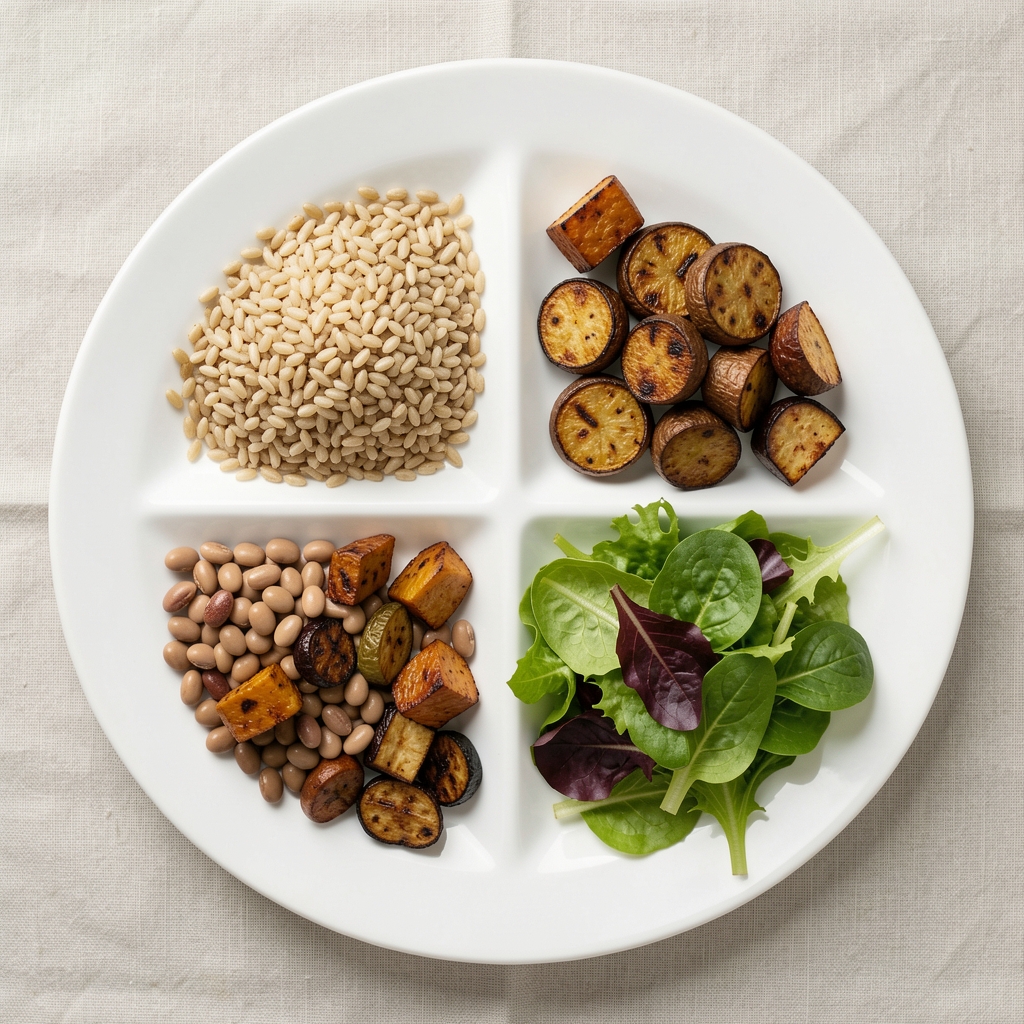
When the plate is regarded as a spatial problem rather than a quantitative one, the task of construction changes. The question becomes not "how many grams of rice?" but "what fraction of this surface is grain?" The latter question is answerable by eye, in real time, without reference to any external standard. It introduces a moment of assessment — a brief pause before the meal is finalised — that functions as a form of attentive engagement with what is about to be eaten.
Across the documented weeks, participants who were given the spatial framing — "aim for four roughly equal zones" — reported finding meal construction easier to maintain than those given weight-based targets. The spatial approach is also self-adjusting: a plate that looks out of balance is easy to correct before sitting down, whereas a plate measured by weight requires the food to be removed and weighed again. The visual, spatial approach has a lower activation threshold.
Grains, Legumes, and the Midday Energy Curve
The relationship between carbohydrate quality and post-meal energy is one of the better-established areas in nutrition research. The distinction between rapidly digestible starches — white rice, refined bread, processed grain products — and slowly digestible ones — whole grain varieties, legumes, resistant starches — has been replicated across a range of study designs and populations. The practical implications are direct: meals structured around slowly digestible carbohydrates tend to produce a flatter, more sustained energy curve through the afternoon, while those dominated by rapidly digestible starches tend to produce a sharper peak followed by a pronounced trough.
In the documented weeks, this pattern was visible in the logs with notable regularity. Meals containing a substantial legume component — lentils, chickpeas, black beans, or edamame occupying roughly a quarter of the plate — produced the most sustained concentration logs through the early afternoon. The legume serves a dual function on the plate: it occupies the carbohydrate zone while also contributing to the protein fraction, making it particularly efficient in terms of plate architecture.
This has practical implications for meal planning. Households that incorporate a legume preparation into two or three midweek lunches are, in effect, using the structural properties of the food itself as a tool for afternoon stability. The planning effort required is modest: a batch of cooked lentils or chickpeas, prepared on Sunday and portioned into the week, provides the relevant ingredient in a form that requires only a few minutes of assembly at midday.
The Role of Vegetables in Structural Meal Design
In the most common pattern observed during the documentation, vegetables occupied the smallest zone on the plate. This was not a deliberate choice by participants — it was the default outcome of meal construction when no structural framework was applied. A portion of pasta with a small side salad, a sandwich with a token slice of tomato, a rice bowl with a scattered handful of spinach — these are representative examples of the vegetable-as-garnish pattern that dominates British midday eating.
When participants were asked to invert this default — to construct the plate around a vegetable base and arrange the other components around it — the outcome was a significant increase in daily vegetable intake without a corresponding increase in total caloric load. The inversion works because vegetables are volumetrically efficient: a large quantity fills the visual field of the plate without meaningfully increasing the meal's energy content, while substantially increasing its fibre, micronutrient, and water content.
The practical instruction that emerged from this observation is simple: lay the vegetables on the plate first, then add the other components around them. This single change in the sequence of meal construction — the sequence in which food is placed on the plate — was the most effective intervention observed across the eight-week documentation period.
- 01 Balanced plates — no single food group exceeding forty percent of total volume — produced the most stable afternoon energy and concentration across all documented weeks.
- 02 Spatial plate construction — assessing proportions by eye — proved easier to maintain than weight-based portion targets across all participant groups.
- 03 Legume-containing meals produced the most sustained afternoon concentration logs, attributable to their dual carbohydrate and protein contribution.
- 04 Constructing the plate vegetable-first — laying greens before adding grains or protein — was the single most effective structural intervention observed.
- 05 Batch-preparing legumes once per week reduces the activation threshold for structured midday meals to a few minutes of assembly.
Meal Planning as Attentional Architecture
The most durable finding from the eight-week documentation period is perhaps the least nutritional: the meals that produced the best outcomes were not the ones with the highest nutritional density, but the ones that had been thought about in advance. The mechanism is attentional rather than biochemical. When a meal has been planned — even loosely, even provisionally — it is constructed with more care than a meal assembled from whatever is immediately available.
This attentional dimension of meal planning is underrepresented in nutrition research, which tends to focus on the specific composition of what is eaten rather than on the conditions under which meals are assembled. The documentation suggests that the planning act itself — the brief, low-effort rehearsal of the midday meal at some point in the morning — produces a measurable improvement in subsequent meal quality, independent of the specific contents of the plan.
A plan does not need to be complete or detailed to have this effect. Participants who noted a single anchor ingredient for their lunch — "chickpeas today", "leftover roasted vegetables" — assembled more structurally balanced plates than those who approached the midday meal without any prior framework. The act of noting one anchor appears sufficient to engage the attentional resources that produce better meal construction.
Articles published on Dranvelo Letters are editorial in nature and reflect the writers' observations on everyday wellness practices. The content is not intended as professional advice, nor as guidance for the management of any specific condition. Readers with specific concerns about their daily routines are encouraged to speak with a qualified wellness professional.